The WAEC Mathematics Syllabus 2026/2027 is an essential guide for candidates preparing for the West African Senior School Certificate Examination (WASSCE).
Mathematics is one of the most important and compulsory subjects in WAEC, required for admission into higher institutions and essential for careers in science, engineering, economics, technology, and social sciences.
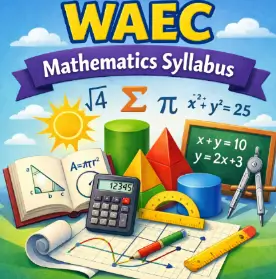
An overview of the WAEC Mathematics syllabus covering algebra, geometry, statistics, and problem-solving skills.
Understanding the syllabus helps students focus on relevant topics, manage their study time effectively, and prepare confidently for both objective and essay examinations. This article provides a detailed explanation of the WAEC Mathematics syllabus for the 2026/2027 academic session, including objectives, topic areas, exam structure, and study tips.
Overview of WAEC Mathematics
WAEC Mathematics tests students’ ability to understand mathematical concepts, apply logical reasoning, and solve real-life problems using numbers, symbols, and formulas. The subject emphasizes accuracy, clarity, and speed.
The examination assesses:
Knowledge of mathematical principles
Problem-solving skills
Logical reasoning
Application of mathematics to everyday situations
Aims and Objectives of the WAEC Mathematics Syllabus 2026/2027
The syllabus aims to enable candidates to:
Develop numerical and computational skills
Apply mathematical knowledge to real-life situations
Understand basic mathematical concepts and relationships
Think logically and solve problems accurately
Prepare for further studies and career development
These objectives guide the structure of the syllabus and the nature of examination questions.
Structure of the WAEC Mathematics Examination
The WAEC Mathematics examination typically consists of:
Paper 1: Objective (Multiple Choice Questions)
Paper 2: Essay (Theory and Problem-Solving Questions)
Candidates are expected to show clear workings, correct methods, and accurate answers.
Detailed WAEC Mathematics Syllabus 2026/2027
Below is a comprehensive breakdown of the major topic areas covered in the syllabus.
1. Number and Numeration
This section forms the foundation of mathematics.
Topics include:
Whole numbers
Fractions and decimals
Approximation and significant figures
Percentages
Ratio and proportion
Students should understand basic operations and their applications in everyday life.
2. Algebraic Processes
Algebra is a major part of WAEC Mathematics.
Key topics:
Simple algebraic expressions
Factorization
Linear equations and inequalities
Simultaneous equations
Algebraic word problems
Candidates must show clear steps when solving algebraic problems.
3. Sets
This section introduces set theory concepts.
Topics include:
Definition of sets
Types of sets
Venn diagrams
Operations on sets
Understanding diagrams and symbols is important for this section.
4. Geometry
Geometry focuses on shapes and spatial reasoning.
Areas covered:
Plane shapes
Angles and lines
Triangles and quadrilaterals
Circles
Polygons
Students should be familiar with the properties of shapes and geometric constructions.
5. Mensuration
Mensuration involves measurement of shapes.
Topics include:
Perimeter and area of plane shapes
Volume and surface area of solids
Units of measurement
Formula memorization and application are essential here.
6. Trigonometry
Trigonometry tests students’ understanding of angles and ratios.
Key topics:
Trigonometric ratios (sine, cosine, tangent)
Angles of elevation and depression
Simple trigonometric problems
This section often appears in essay questions.
7. Coordinate Geometry
This section combines algebra and geometry.
Topics include:
Cartesian plane
Distance between two points
Midpoint of a line
Graphs of linear equations
Candidates should be able to plot graphs accurately.
8. Statistics
Statistics focuses on data collection and interpretation.
Areas covered:
Data presentation (tables, charts, graphs)
Mean, median, and mode
Range and basic probability
Understanding real-life data interpretation is important.
9. Probability
Probability introduces chance and likelihood.
Topics include:
Simple probability experiments
Probability of events
Use of fractions and ratios
This section is usually straightforward with regular practice.
10. Commercial Mathematics
This section focuses on financial applications.
Topics include:
Simple interest
Profit and loss
Discounts
Hire purchase
These topics are highly practical and useful in everyday life.
11. Logic and Reasoning
Logical thinking is an important part of mathematics.
Topics include:
Logical statements
Simple reasoning
Problem analysis
Students are expected to apply reasoning skills to solve problems.
SEE ALSO:
Tips for Studying WAEC Mathematics Effectively
Study directly from the syllabus
Practice calculations daily
Learn and understand formulas
Solve past WAEC questions
Show clear workings in essay questions
Manage time effectively during exams
Consistent practice is the key to success in WAEC Mathematics.
Download the PDF for WAEC Civic Education Syllabus 2026/2027
Why Download the WAEC Civic Education Syllabus?
- To understand the exam format and content
- To prepare effectively for the exam
- To get familiar with the marking scheme and grading system
Click below 👇 to View and download PDF
WAEC MATHEMATICS SYLLABUS (DOWNLOAD)
Frequently Asked Questions (FAQ) – WAEC Mathematics Syllabus 2026/2027
1. What is the WAEC Mathematics Syllabus for 2026/2027?
The WAEC Mathematics Syllabus 2026/2027 is the official guide that outlines all the topics, objectives, and assessment areas candidates must study for the Mathematics paper in the West African Senior School Certificate Examination (WASSCE).
2. Is Mathematics compulsory in WAEC?
Yes. Mathematics is a compulsory subject for all WAEC candidates and is required for admission into higher institutions.
3. Has the WAEC Mathematics syllabus changed for 2026/2027?
The core content remains largely the same, but WAEC may adjust emphasis on certain topics. Students are advised to study the full syllabus and stay updated through official WAEC announcements.
4. What are the major topics in the WAEC Mathematics syllabus?
Major topics include:
Number and numeration
Algebra
Geometry
Mensuration
Trigonometry
Statistics
Probability
Commercial mathematics
5. How many papers are there in WAEC Mathematics?
WAEC Mathematics usually consists of two papers:
Paper 1: Objective (multiple-choice questions)
Paper 2: Essay (theory and problem-solving questions)
6. Does WAEC Mathematics include practical examinations?
No. WAEC Mathematics does not have a practical exam. Assessment is based on written objective and essay papers.
7. Is the use of a calculator allowed in WAEC Mathematics?
Yes. Candidates are allowed to use non-programmable calculators approved by WAEC during the examination.
8. Which topics are most important in WAEC Mathematics?
All topics are important, but algebra, geometry, trigonometry, mensuration, and statistics frequently appear in both objective and essay sections.
9. How can I prepare effectively for WAEC Mathematics?
Effective preparation includes:
Studying the syllabus thoroughly
Practicing calculations daily
Solving past WAEC questions
Understanding formulas and methods
Managing time during practice tests
10. Is WAEC Mathematics difficult to pass?
WAEC Mathematics is manageable with consistent practice and proper understanding of concepts. Regular revision improves performance significantly.
11. Do I need to memorize formulas for WAEC Mathematics?
Yes, basic formulas are important. However, understanding how and when to apply them is more important than memorization alone.
12. How important are workings in WAEC Mathematics essay questions?
Very important. Clear and correct workings earn marks even if the final answer is incorrect.
13. Can I score high in WAEC Mathematics without attending extra lessons?
Yes. With disciplined self-study, proper use of textbooks, and consistent practice of past questions, many students perform very well without extra lessons.
14. When should I start preparing for WAEC Mathematics 2026/2027?
Early preparation is recommended. Starting at least 6–9 months before the examination allows enough time for revision and mastery.
Conclusion
The WAEC Mathematics Syllabus 2026/2027 provides a clear roadmap for students preparing for the examination. By understanding the syllabus structure and topic areas, candidates can focus their efforts, avoid unnecessary stress, and improve their performance. With dedication, practice, and proper guidance, success in WAEC Mathematics is achievable.