The WAEC GCE Physics Syllabus 2026/2027 is the official roadmap for all private candidates preparing for the West African Senior School Certificate Examination (WASSCE) for Private Candidates. It contains every topic, practical skill, and learning objective that WAEC will test in Physics.
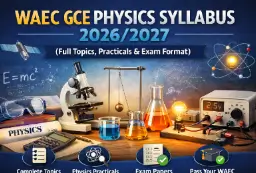
Visual guide to the WAEC GCE Physics Syllabus 2026/2027 including key topics, practical experiments, and exam structure
Whether you are writing WAEC GCE Physics for admission into engineering, medicine, technology, or any science-based course, this syllabus is the most important document you must use. Studying outside it is a waste of time. Studying inside it is how you pass.
This guide presents the full topic list, exam structure, practical areas, and smart preparation strategy in one place.
What Is WAEC GCE?
WAEC GCE stands for West African Examinations Council – General Certificate Examination. It is the private-candidate version of the WAEC exam.
WAEC GCE is accepted by:
Nigerian universities
Polytechnics
Colleges of education
Foreign institutions
Physics is a core science subject for candidates applying for engineering, physics, architecture, aviation, medicine, and technology-based courses.
PEOPLE SEARCH:
⇒WAEC GCE Economics Syllabus 2026/2027 Topics
⇒WAEC GCE Economics Syllabus 2026/2027 Topics
⇒WAEC GCE Mathematics Syllabus 2026 Topics
⇒WAEC GCE English Syllabus 2026: Latest Guide
Why the WAEC GCE Physics Syllabus Is Important
The syllabus helps you:
Know exactly what WAEC will set
Avoid studying irrelevant topics
Prepare correctly for practical exams
Understand how questions are structured
Students who fail WAEC Physics usually fail because they do not follow the syllabus.
WAEC GCE Physics Exam Format
WAEC GCE Physics is divided into three papers:
| Paper | Type |
|---|---|
| Paper 1 | Objective (multiple choice) |
| Paper 2 | Theory |
| Paper 3 | Practical |
All questions are taken directly from the syllabus.
WAEC GCE Physics Syllabus 2026/2027 – Full Topics
The Physics syllabus is divided into five main sections.
1. Measurement and Units
Physical quantities and units
Scalars and vectors
Measurement of length, mass, and time
SI units
2. Motion
Speed, velocity, and acceleration
Equations of motion
Graphs of motion
Free fall
3. Force and Energy
Newton’s laws of motion
Work, energy, and power
Gravitation
Friction
4. Properties of Matter
Elasticity
Pressure in liquids and gases
Surface tension
Capillarity
5. Heat and Thermodynamics
Temperature
Heat transfer
Gas laws
Change of state
6. Waves
Types of waves
Sound waves
Light waves
Reflection and refraction
7. Electricity
Electric charge
Current and voltage
Ohm’s law
Electrical circuits
8. Magnetism
Magnetic fields
Electromagnets
Earth’s magnetic field
9. Electronics
Diodes
Transistors
Integrated circuits
10. Atomic and Nuclear Physics
Structure of the atom
Radioactivity
Nuclear energy
WAEC GCE Physics Practical Areas
The practical exam tests:
Measurement of length and mass
Density experiments
Electrical circuits
Simple pendulum
Optics experiments
You must know how to:
Read instruments
Record values
Draw graphs
Calculate results
How to Study Using the WAEC GCE Physics Syllabus
Follow this method:
Read each topic in the syllabus
Use a Physics textbook
Solve WAEC past questions
Practice calculations
Practice practical experiments
Best Physics Preparation Tips
Master formulas
Understand concepts, not cramming
Practice calculations daily
Focus on practicals
Revise past questions
Why Many Students Fail WAEC GCE Physics
Most students fail because they:
Ignore the syllabus
Don’t practice calculations
Avoid practicals
Guess in exams
Why Physics Is Important as a Subject
1. Physics explains how nature works
Physics helps us understand:
Motion of cars and airplanes
How electricity flows
How sound travels
Why objects fall
How light works
Everything around us follows physical laws. Without Physics, modern technology would not exist.
2. Physics is the foundation of technology
Most of today’s technology is based on Physics, including:
Mobile phones
Computers
Television
Satellites
Internet
Medical equipment
Engineers and scientists use Physics to design machines, buildings, and electronic devices.
3. Physics develops problem-solving skills
Physics trains your brain to:
Analyze problems
Think logically
Use formulas
Solve calculations
These skills are useful in exams, careers, and everyday life.
4. Physics is required for many careers
You need Physics to study:
Engineering
Medicine
Architecture
Aviation
Computer science
Technology
Physics and Astronomy
Without Physics, many science and technical courses are not possible.
5. Physics improves understanding of other sciences
Physics helps you understand:
Chemistry (energy, atoms)
Biology (muscles, blood flow, eyesight)
Geography (climate, weather)
It connects all sciences together.
6. Physics is important for WAEC and JAMB
Physics is a core subject for science students in WAEC, NECO, NABTEB, and JAMB. A good Physics result increases your chances of getting admission into science-based courses.
7. Physics builds creativity and innovation
Physics teaches you how to:
Build machines
Design experiments
Invent new technologies
Solve real-life problems
Many great inventions started from Physics knowledge.
Physics is not just a school subject—it is the language of the universe. It explains how things work, supports modern technology, and opens the door to high-paying careers. That is why Physics is one of the most important subjects for students who want to succeed in science and technology.
Frequently Asked Questions (FAQ)
1. What is the WAEC GCE Physics Syllabus for 2026/2027?
The WAEC GCE Physics Syllabus 2026/2027 is the official document that lists all the topics, practical skills, and objectives candidates must study for the WAEC private examination in Physics.
2. Is the WAEC GCE Physics syllabus different from school WAEC?
No. The WAEC GCE Physics syllabus is the same as the school (May/June) WAEC syllabus. Both follow the same topics, practical structure, and marking scheme.
3. Does WAEC GCE Physics include practical exams?
Yes. WAEC GCE Physics includes a practical paper that tests experiments such as electricity, optics, density, and measurements.
4. How many papers are there in WAEC GCE Physics?
There are three papers:
Paper 1 (Objective)
Paper 2 (Theory)
Paper 3 (Practical)
5. Which topics are most important in WAEC GCE Physics?
Key topics include:
Motion
Electricity
Waves
Heat
Mechanics
Atomic Physics
These areas appear every year.
6. Can I use school WAEC past questions to study for GCE Physics?
Yes. School WAEC and GCE use the same syllabus, so all WAEC Physics past questions are relevant for GCE candidates.
7. How can I pass WAEC GCE Physics easily?
To pass:
Study strictly from the WAEC GCE Physics syllabus
Practice calculations daily
Solve past questions
Master practical experiments
8. Is Physics compulsory for science students in WAEC GCE?
Yes. Physics is compulsory for candidates applying for engineering, technology, medical, and science-based courses.
Conclusion
The WAEC GCE Physics Syllabus 2026/2027 is your official success guide. Every question WAEC will ask comes from this syllabus. If you study it properly, practice calculations, and master practicals, passing Physics becomes easy.
Follow the syllabus, and your result will follow.
We Don’t provide or support any form of Malpractice acts, But provide informations that will help you achieve a good Academic Results.