WAEC GCE Mathematics Syllabus 2026 Topics – Complete Guide for Private Candidates
The WAEC GCE Mathematics syllabus for 2026 is one of the most important documents every private candidate needs before sitting for the West African Senior School Certificate Examination (WASSCE) for Private Candidates, popularly known as WAEC GCE. Mathematics is a compulsory subject and plays a vital role in determining admission into universities, polytechnics, colleges of education, and professional programs across West Africa.
Whether you are rewriting WAEC to improve your result, or sitting for the exam for the first time as a private candidate, understanding the WAEC GCE Mathematics syllabus 2026 topics will give you a clear roadmap of what to study, how to prepare, and how to score high.
This comprehensive guide explains all the syllabus topics in a simple and structured way, while also offering expert study tips to help you succeed.
What Is WAEC GCE?
WAEC GCE stands for West African Examinations Council – General Certificate Examination. It is designed for private candidates who are not in regular secondary school programs. The exam is conducted in two series every year:
First Series (January–February)
Second Series (August–September)
Candidates who pass WAEC GCE Mathematics can use their results to gain admission into universities, polytechnics, nursing schools, and other institutions.
Structure of WAEC GCE Mathematics Examination
WAEC GCE Mathematics is divided into two papers:
Paper 1 (Objective Test)
50 multiple-choice questions
1 hour
Tests speed and accuracy
Paper 2 (Theory and Essay)
Long-answer questions
2½ hours
Tests understanding, calculations, and problem-solving
Both papers cover the same syllabus, so mastering the topics is essential.
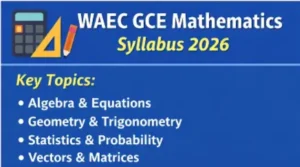
WAEC GCE Mathematics Syllabus 2026 Topics – Full List
Below are WAEC GCE Mathematics Syllabus 2026 Topics areas candidates must study for the 2026 examination.
1. Number and Numeration
This section tests your ability to understand numbers and their operations.
Topics include:
Natural numbers, whole numbers, and integers
Rational and irrational numbers
Place value and rounding off
Number bases (binary, base 5, base 10, etc.)
Fractions, decimals, and percentages
Standard form (scientific notation)
Approximations and errors
You must know how to convert numbers from one base to another and perform operations such as addition, subtraction, multiplication, and division.
2. Algebraic Processes
This is one of the most important parts of the syllabus.
Topics include:
Algebraic expressions
Simplification of algebraic fractions
Linear equations
Simultaneous equations
Quadratic equations
Word problems
Inequalities
Candidates should be able to solve equations and apply algebra to real-life problems.
3. Indices, Logarithms, and Surds
These topics deal with powers and roots.
You will study:
Laws of indices
Exponential expressions
Logarithmic laws
Solving equations involving logarithms
Surds and rationalization
Understanding these concepts helps in handling large numbers and simplifying complex expressions.
4. Sets and Venn Diagrams
This topic helps candidates organize information logically.
Topics include:
Definition of sets
Union and intersection
Subsets and complements
Venn diagrams
Word problems involving sets
You should be able to draw and interpret Venn diagrams accurately.
5. Functions and Graphs
This section links algebra to geometry.
Topics include:
Linear functions
Graphs of linear equations
Graphs of quadratic functions
Interpreting graphs
Gradient and intercept
Candidates should know how to draw graphs neatly and read information from them.
6. Geometry
Geometry focuses on shapes and their properties.
Topics include:
Angles and lines
Triangles
Quadrilaterals
Polygons
Circles (chords, tangents, arcs)
Construction of angles and shapes
Geometry questions often test logic and spatial understanding.
7. Mensuration
This involves measuring shapes.
Topics include:
Perimeter and area of plane shapes
Volume of solids
Surface area
Cylinders, cones, pyramids, and spheres
You must remember formulas and apply them correctly.
8. Trigonometry
One of the most important scoring areas in WAEC Mathematics.
Topics include:
Sine, cosine, and tangent
Trigonometric ratios
Angles of elevation and depression
Sine rule and cosine rule
Bearings
Trigonometry is heavily tested in both objective and theory papers.
9. Statistics and Probability
This section deals with data.
Topics include:
Mean, median, and mode
Frequency tables
Bar charts and histograms
Probability
Range
Candidates must be able to analyze and interpret data.
10. Vectors and Matrices
These are advanced topics in WAEC GCE Mathematics.
Topics include:
Vector representation
Addition and subtraction of vectors
Magnitude and direction
Matrix operations
Determinants
These questions often carry high marks in the theory paper.
RELATED SEARCH:
⇒WAEC GCE English Syllabus 2026: Latest Guide
How to Prepare for WAEC GCE Mathematics Syllabus 2026 Topics
To succeed WAEC GCE Mathematics Syllabus 2026 Topics , you should:
Study the syllabus carefully
Use recommended WAEC textbooks
Practice past questions
Learn formulas and rules
Solve questions daily
Take mock tests
Understanding concepts is more important than memorizing answers.
Best Books for WAEC GCE Mathematics Syllabus 2026 Topics
Some useful books for WAEC GCE Mathematics Syllabus 2026 Topics include:
New General Mathematics
Essential Mathematics for Senior Secondary Schools
WAEC Past Questions and Answers
These books follow the official WAEC syllabus.
Common Mistakes to Avoid
WAEC GCE Mathematics Syllabus 2026 Topics, Many candidates fail because they:
Ignore some topics
Do not practice enough
Forget formulas
Misread questions
Manage time poorly
Avoid these mistakes to improve your score.
Conclusion
The WAEC GCE Mathematics Syllabus 2026 Topics covers everything from basic arithmetic to advanced algebra and geometry. By studying all the listed topics and practicing regularly, you can achieve an excellent grade and improve your chances of getting admission into your preferred institution.
Start early, stay consistent, and use the syllabus as your study guide.