The WAEC GCE Chemistry Syllabus 2026/2027 contains all the topics, practical skills, and exam objectives private candidates must study to pass the WAEC Chemistry examination. This page provides the official topic list, exam format, and practical areas.
If you are preparing for the WAEC GCE Chemistry exam in 2026/2027, understanding the official syllabus is the first and most important step. The syllabus outlines all the topics, practical areas, and learning objectives that will be tested in the examination.
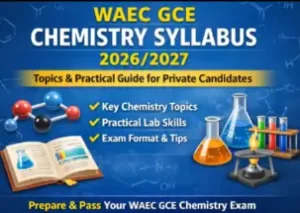
Visual guide to the WAEC GCE Chemistry syllabus 2026/2027 with exam topics and laboratory tools
What is WAEC GCE?
WAEC GCE is an examination organized by the West African Examinations Council (WAEC) for candidates who are not currently in secondary school. It is commonly called Private Candidate Examination.
The result obtained from WAEC GCE is accepted by:
Nigerian universities
Polytechnics
Colleges of education
Foreign institutions
Chemistry is a core subject for most science-related courses, making it one of the most important exams for many candidates.
Purpose of the WAEC GCE Chemistry Syllabus 2026/2027
The WAEC GCE Chemistry syllabus is designed to:
Test your understanding of chemical principles
Measure your ability to apply chemistry to real-life situations
Evaluate your knowledge of laboratory skills
Prepare you for further education in science-based courses
By studying the syllabus, you can focus only on what WAEC will test and avoid wasting time on irrelevant topics.
Structure of the WAEC GCE Chemistry Syllabus 2026/2027 Exam
The Chemistry exam is divided into three papers:
Paper 1 – Objective Test
This contains multiple-choice questions that cover the entire syllabus.
Paper 2 – Theory
This includes structured and essay questions where you explain chemical concepts and solve calculations.
Paper 3 – Practical
This tests your laboratory skills, observation, and data interpretation.
WAEC GCE Chemistry Syllabus 2026/2027 – Full Topic Breakdown
The Chemistry syllabus is divided into physical, organic, and inorganic chemistry.
1. Basic Concepts in Chemistry
Matter and its properties
States of matter
Separation of mixtures
Chemical and physical changes
Elements, compounds, and mixtures
2. Atomic Structure and Bonding
Atoms, molecules, and ions
Atomic number and mass number
Electron configuration
Chemical bonding (ionic, covalent, metallic)
Periodic table
3. Stoichiometry
Chemical equations
Mole concept
Calculations involving masses and volumes
Percentage composition
4. Acids, Bases, and Salts
Definitions and properties
pH scale
Preparation of salts
Uses of acids and bases
5. Oxidation and Reduction
Redox reactions
Oxidation states
Electrochemical cells
6. Energy Changes
Exothermic and endothermic reactions
Energy profiles
Enthalpy changes
7. Chemical Kinetics
Rate of reaction
Factors affecting reaction rate
8. Equilibrium
Chemical equilibrium
Le Chatelier’s principle
9. Non-Metals and Their Compounds
Hydrogen
Oxygen
Nitrogen
Carbon and its compounds
10. Metals and Their Compounds
Alkali metals
Alkaline earth metals
Transition metals
Extraction of metals
11. Organic Chemistry
Alkanes
Alkenes
Alkynes
Alcohols
Carboxylic acids
Polymers
12. Petroleum and Petrochemicals
Crude oil
Refining
Uses of petroleum products
13. Environmental Chemistry
Air pollution
Water pollution
Chemical waste management
14. Chemistry in Industry
Fertilizers
Cement
Glass
Soap and detergents
RELATED SEARCH:
⇒WAEC GCE Biology Syllabus 2026/2027 Topics
⇒WAEC GCE Economics Syllabus 2026/2027 Topics
⇒WAEC GCE Mathematics Syllabus 2026 Topics
⇒WAEC GCE English Syllabus 2026: Latest Guide
WAEC GCE Chemistry Practical Areas
Practical chemistry focuses on:
Qualitative analysis
Quantitative analysis
Acid-base titration
Tests for gases
Identification of salts
Candidates must understand laboratory safety and correct use of equipment.
How to Study Using the WAEC GCE Chemistry Syllabus 2026/2027
To pass Chemistry, follow these steps:
Study each topic listed in the syllabus
Use WAEC-recommended textbooks
Practice calculations regularly
Solve past questions
Practice laboratory experiments
Recommended Chemistry Textbooks
Some widely used Chemistry textbooks include:
Senior Secondary Chemistry texts
Practical chemistry manuals
WAEC past questions
Why the WAEC GCE Chemistry Syllabus 2026/2027 is Important
The syllabus helps you:
Know exactly what to study
Prepare for both theory and practical
Avoid unnecessary topics
Build confidence for the exam
Frequently Asked Questions (FAQ)
1. What is the WAEC GCE Chemistry Syllabus for 2026/2027?
The WAEC GCE Chemistry syllabus for 2026/2027 is the official list of topics, practical areas, and learning objectives that candidates must study to prepare for the Chemistry examination for private candidates.
2. Is the WAEC GCE Chemistry syllabus the same as the school WAEC syllabus?
Yes, the WAEC GCE Chemistry syllabus is the same as the syllabus used for school candidates. Both follow the same curriculum and cover identical Chemistry topics.
3. Does the WAEC GCE Chemistry exam include practicals?
Yes, the WAEC GCE Chemistry examination includes a practical paper that tests laboratory skills, observation, titration, and identification of chemical substances.
4. How many papers are there in WAEC GCE Chemistry?
There are three papers:
Paper 1 (Objective)
Paper 2 (Theory)
Paper 3 (Practical)
5. Which topics are most important in WAEC GCE Chemistry?
Important topics include:
Stoichiometry
Acids, bases, and salts
Organic chemistry
Periodic table
Chemical bonding
Redox reactions
Qualitative and quantitative analysis
All topics in the syllabus are important and should be studied.
6. How can I pass WAEC GCE Chemistry easily?
To pass WAEC GCE Chemistry:
Study the full syllabus
Practice past questions
Understand chemical calculations
Practice laboratory experiments
Use recommended textbooks
7. Can I use WAEC school past questions for WAEC GCE Chemistry?
Yes. WAEC school past questions and WAEC GCE past questions are based on the same syllabus, so both are useful for preparation.
8. Where can I get the official WAEC GCE Chemistry syllabus?
The syllabus is available through WAEC publications, exam registration centers, and reliable education websites.
9. Is Chemistry compulsory for science students in WAEC GCE?
Chemistry is required for most science-related courses such as Medicine, Pharmacy, Engineering, and Biological Sciences.
10. Can I self-study using the WAEC GCE Chemistry syllabus?
Yes. With the syllabus, textbooks, and past questions, candidates can successfully prepare on their own for the WAEC GCE Chemistry exam.
Conclusion
The WAEC GCE Chemistry Syllabus 2026/2027 is a complete guide that shows everything you need to know to succeed in the exam. By carefully studying each topic, practicing calculations, and improving your laboratory skills, you can greatly increase your chances of scoring high in Chemistry.
Understanding the syllabus and following it closely will help you prepare smarter and achieve your academic goals.