The WAEC Chemistry Syllabus 2026/2027 serves as the official roadmap for candidates preparing for the West African Senior School Certificate Examination (WASSCE). Chemistry is a core science subject for students pursuing careers in medicine, pharmacy, engineering, environmental science, food technology, and many other science-based disciplines.
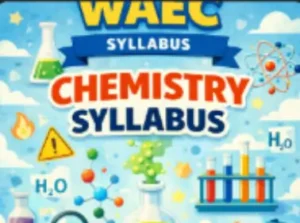
An overview of the WAEC Chemistry syllabus highlighting key theory topics and practical laboratory requirements.
Understanding the waec Chemistry syllabus is crucial because it helps students focus on examinable topics, organize their study plans, and prepare effectively for both theory and practical examinations. This comprehensive guide explains the structure, objectives, major topic areas, practical requirements, and study tips for the WAEC Chemistry examination.
Overview of WAEC Chemistry
WAEC Chemistry assesses students’ understanding of chemical principles, laboratory skills, and the application of chemistry to everyday life. The examination tests both theoretical knowledge and practical competence, ensuring that candidates can explain chemical concepts and perform basic experiments.
The syllabus emphasizes:
Scientific reasoning and accuracy
Safe laboratory practices
Interpretation of experimental results
Problem-solving skills
Aims and Objectives of the WAEC Chemistry Syllabus 2026/2027
The WAEC Chemistry syllabus aims to enable candidates to:
Understand fundamental chemical concepts and laws
Develop practical laboratory skills
Apply chemistry to industry, health, and the environment
Observe safety and accuracy in experimental work
Prepare for further studies in science-related fields
These objectives guide the selection of topics and the structure of examination questions.
Structure of the WAEC Chemistry Examination
WAEC Chemistry typically consists of:
Objective Test (Multiple Choice)
Theory Paper (Essay and Calculations)
Practical Examination or Alternative to Practical
Candidates must prepare thoroughly for all three components.
Detailed WAEC Chemistry Syllabus 2026/2027
Below is a detailed breakdown of the major areas covered in the waec Chemistry syllabus.
1. Introduction to Chemistry
This section introduces students to basic laboratory concepts.
Topics include:
Nature and scope of chemistry
Laboratory apparatus and their uses
Safety rules in the chemistry laboratory
Symbols, formulas, and chemical equations
Students are expected to identify common laboratory equipment and follow safety guidelines.
2. Particulate Nature of Matter
This section explains the composition and behavior of matter.
Key topics:
Atoms, molecules, and ions
Kinetic theory of matter
States of matter (solid, liquid, gas)
Changes of state
Understanding particle behavior is essential for later topics.
3. Atomic Structure and Periodicity
This area focuses on the building blocks of matter.
Topics include:
Structure of the atom
Proton, neutron, and electron
Atomic and mass numbers
Periodic table and periodic trends
Students should understand how atomic structure influences chemical properties.
4. Chemical Bonding
Chemical bonding explains how atoms combine.
Areas covered:
Ionic bonding
Covalent bonding
Metallic bonding
Intermolecular forces
This topic often appears in both objective and theory questions.
5. Stoichiometry and Chemical Calculations
This is a highly tested section in WAEC Chemistry.
Topics include:
Relative atomic and molecular masses
Mole concept
Chemical equations and balancing
Percentage composition
Students must practice calculations regularly to gain confidence.
6. Acids, Bases, and Salts
This section focuses on chemical reactions and properties.
Key topics:
Properties of acids and bases
pH scale
Preparation of salts
Uses of acids, bases, and salts
Understanding laboratory preparation methods is important for practical exams.
7. States of Matter and Gas Laws
This area explains the behavior of gases and liquids.
Topics include:
Gas laws
Diffusion
Vapor pressure
Kinetic theory of gases
Candidates may be required to solve simple gas law problems.
8. Energy Changes and Chemical Reactions
This section introduces energy concepts in chemistry.
Areas covered:
Exothermic and endothermic reactions
Energy profile diagrams
Catalysts
WAEC often tests definitions and diagrams here.
9. Rates of Chemical Reactions
This topic explains factors affecting reaction speed.
Topics include:
Effect of temperature
Concentration
Surface area
Catalysts
Students should understand both theoretical explanations and simple experiments.
10. Redox Reactions and Electrochemistry
This section covers electron transfer reactions.
Key areas:
Oxidation and reduction
Electrolysis
Uses of electrolysis
Electrolysis experiments are common in practical exams.
11. Organic Chemistry
Organic chemistry is an important and scoring section.
Topics include:
Hydrocarbons
Alkanes, alkenes, and alkynes
Alcohols and organic acids
Uses of organic compounds
Students should understand reactions and uses rather than memorizing formulas alone.
12. Chemistry of Non-Metals and Metals
This section explains chemical properties of elements.
Topics include:
Properties of metals
Extraction of metals
Corrosion and prevention
Properties of non-metals
Understanding industrial applications is important.
13. Environmental and Industrial Chemistry
This section links chemistry to real life.
Areas covered:
Air and water pollution
Fertilizers and pesticides
Chemical industries
WAEC may test environmental awareness and applications.
SEE ALSO:
WAEC Syllabus for English Language
WAEC Chemistry Practical Examination 2026/2027
The practical exam tests:
Identification of laboratory apparatus
Qualitative and quantitative analysis
Observations and inferences
Safety and accuracy
Regular practical practice is essential for success.
Tips for Studying WAEC Chemistry Effectively
Study directly from the syllabus
Practice calculations frequently
Perform laboratory experiments regularly
Revise past WAEC questions
Understand concepts instead of memorizing
Manage time during exams
Download the PDF for WAEC Chemistry Syllabus 2026/2027
Why Download the WAEC Chemistry Syllabus?
- To understand the exam format and content
- To prepare effectively for the exam
- To get familiar with the marking scheme and grading system
Click below 👇 to download
WAEC CHEMISTRY SYLLABUS PDF (DOWNLOAD)
Conclusion
The WAEC Chemistry Syllabus 2026/2027 provides a clear guide for students preparing for the examination. By understanding the syllabus structure, topic areas, and practical requirements, candidates can prepare effectively and improve their chances of success. With consistent study and practical practice, achieving a good grade in WAEC Chemistry is realistic.