The WAEC GCE Technical Drawing Syllabus 2026/2027 requires a clear understanding of the official syllabus, exam structure, and the practical skills expected from candidates. Technical Drawing is a precision-based subject that evaluates a student’s ability to interpret engineering concepts, apply geometrical constructions, and present accurate graphical solutions using standard drawing instruments. For many students, success in this subject depends largely on early preparation and familiarity with the areas most frequently tested by WAEC.
Overview of WAEC GCE Technical Drawing Syllabus 2026/2027
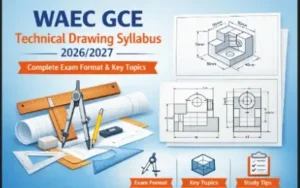
Illustration showing the WAEC GCE Technical Drawing syllabus, key topics, and exam format for the 2026/2027 examination.
Technical Drawing is a practical-based subject that tests a student’s ability to interpret, construct, and present engineering and geometrical drawings accurately.
The WAEC GCE examination is designed to assess:
Knowledge of drawing instruments and materials
Understanding of geometrical constructions
Ability to produce accurate orthographic and pictorial drawings
Skills in interpreting engineering drawings and plans
Proper dimensioning and scaling techniques
Because this subject is highly practical, consistent practice is essential for success.
WAEC GCE Technical Drawing Syllabus 2026/2027
The syllabus is structured to cover both basic drawing principles and advanced engineering drawing applications. Below are the major areas candidates should focus on.
1. Drawing Instruments and Materials
Students must understand:
Types and uses of drawing boards, T-squares, and set squares
Pencils, compasses, dividers, and erasers
Scales and measurement tools
Proper care and maintenance of drawing equipment
This section forms the foundation of all technical drawing activities.
2. Lines, Lettering, and Dimensioning
Candidates are expected to learn:
Types of lines used in technical drawing
Standard lettering styles and spacing
Rules of dimensioning and labeling
Application of scale in drawings
These principles ensure clarity, accuracy, and professional presentation.
3. Geometrical Constructions
This is one of the most important sections of the syllabus. Topics include:
Construction of triangles, polygons, and circles
Division of lines and angles
Tangents and loci
Enlargement and reduction of figures
Students should practice these constructions repeatedly since they appear frequently in exams.
4. Plane Geometry and Solid Geometry
Candidates must understand:
Properties of plane figures
Surface development of simple solids
Intersection of solids
True shapes and true lengths
These concepts are essential for solving real engineering drawing problems.
5. Orthographic Projection
Orthographic projection is a core examination topic. Students will learn:
First-angle and third-angle projection
Projection of points, lines, and planes
Projection of simple solids
Interpretation of given views
Mastering orthographic drawing significantly improves exam performance.
6. Isometric and Oblique Drawing
This section covers:
Principles of isometric projection
Drawing isometric views of simple objects
Oblique drawing methods (cabinet and cavalier)
Converting orthographic views to pictorial views
These skills test visualization and spatial understanding.
7. Engineering Drawing and Building Drawing
Students are required to study:
Basic machine components
Assembly drawings
Building plans and elevations
Sections and symbols used in construction drawings
This part links technical drawing to real-life engineering and architecture.
WAEC GCE Technical Drawing Exam Format 2026/2027
Understanding the exam structure helps candidates prepare effectively.
Paper Structure
The examination usually consists of:
Paper 1 – Objective Questions
Multiple-choice questions
Covers theory and drawing principles
Tests general understanding of the syllabus
Paper 2 – Practical Drawing
Major drawing tasks using instruments
May include orthographic, isometric, or geometrical construction
Requires accuracy, neatness, and correct dimensioning
The practical paper carries higher marks, making practice extremely important.
Marking Scheme
Examiners typically award marks based on:
Accuracy of construction
Correct use of scale and dimension
Neatness and clarity of drawing
Proper labeling and presentation
Even small mistakes can reduce scores, so precision matters.
Important Topics Likely to Appear in WAEC GCE Technical Drawing Syllabus 2026/2027
Although WAEC does not release exact questions, repeated trends show that the following areas appear often:
Geometrical constructions
Orthographic projection of solids
Isometric drawing of machine parts
Surface development of solids
Dimensioning and scaling
Students should prioritize these topics during revision.
RELATED POSTS:
⇒WAEC GCE Home Management past questions 2026/2027
⇒WAEC GCE Financial Accounting past questions 2026/2027
⇒WAEC GCE Government syllabus & questions PDF
Best Study Tips for WAEC GCE Technical Drawing
1. Practice Daily Drawing
Technical Drawing is skill-based. Regular practice improves:
Speed
Accuracy
Confidence
2. Use Correct Instruments
Always work with standard drawing tools to avoid mistakes during the exam.
3. Study Past Questions
Past WAEC questions help students:
Understand exam patterns
Identify repeated topics
Improve time management
4. Focus on Neatness
Clear, clean drawings often score higher marks than rough work.
5. Revise the Full Syllabus
Do not depend only on predictions. Cover every topic in the syllabus.
Common Mistakes Students Should Avoid | WAEC GCE Technical Drawing Syllabus 2026/2027
Ignoring dimensioning rules
Using the wrong projection method
Poor labeling of drawings
Untidy presentation
Lack of practice before the exam
Avoiding these errors can significantly improve results.
Why the WAEC GCE Technical Drawing Syllabus 2026/2027 Matters
Understanding the official syllabus helps students:
Know exactly what to study
Avoid wasting time on irrelevant topics
Prepare strategically for high scores
Serious candidates always begin preparation by studying the syllabus carefully.
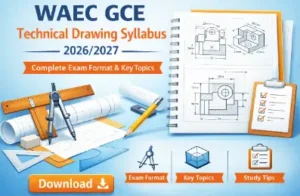
Visual study guide showing key topics, exam format, and drawing instruments for WAEC GCE Technical Drawing 2026/2027.
Frequently Asked Questions (FAQ) | WAEC GCE Technical Drawing Syllabus 2026/2027
Is WAEC GCE Technical Drawing difficult?
It is not difficult for students who practice regularly and understand the syllabus.
How many papers are written in Technical Drawing?
Usually two papers – objective and practical drawing.
Which topics are most important?
Orthographic projection, geometrical construction, and isometric drawing are frequently tested.
Can I pass without practicing drawing?
No. Technical Drawing requires consistent practical work.
Where can I get the official syllabus?
The syllabus is available through WAEC-approved educational resources and exam guides.
Conclusion
The WAEC GCE Technical Drawing syllabus 2026/2027 provides a complete roadmap for students preparing for the examination. By understanding the key topics, exam format, and marking scheme, candidates can study more effectively and increase their chances of success.
Consistent practice, correct use of drawing instruments, and thorough revision of the syllabus remain the most reliable strategies for achieving excellent grades in Technical Drawing.
Students who start preparation early and follow the guidance in this article will be well-positioned to perform confidently in the upcoming WAEC GCE examination.