Download the complete WAEC GCE Civic Education Syllabus 2026/2027 with exam format, marking scheme, topic breakdown, and smart study tips to pass in one sitting.
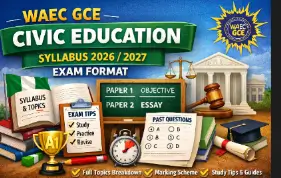
Official WAEC GCE Civic Education Syllabus 2026/2027 covering citizenship, democracy, human rights, and Nigerian constitution
WAEC GCE Civic Education Syllabus 2026/2027 Exam Format
The WAEC GCE Civic Education Syllabus 2026/2027 is designed to test candidates’ understanding of citizenship, democracy, governance, human rights, and national development. This guide explains the full syllabus, exam format, marking structure, and how to study effectively for high scores.
If you are preparing for the West African Examinations Council (WAEC) General Certificate Examination (GCE), Civic Education is one of the most scoring subjects when studied properly.
This article gives you everything you need — from syllabus topics to how WAEC sets questions.
What Is Civic Education in WAEC GCE?
Civic Education is a subject that teaches students their rights, duties, responsibilities, and roles in society. In the WAEC GCE exam, it helps candidates understand democracy, law, leadership, citizenship, and national unity.
WAEC uses Civic Education to test:
Knowledge of Nigeria’s political system
Understanding of human rights
Awareness of national values
Responsibilities of citizens
WAEC GCE Civic Education Syllabus 2026/2027 (Full Topics)
The WAEC GCE Civic Education Syllabus 2026/2027 is divided into major sections. Each section focuses on building responsible, informed, and active citizens.
Section A – Citizenship
This section covers:
Meaning of citizenship
Types of citizenship
Rights and duties of citizens
Responsibilities of citizens
Privileges of citizenship
You will be tested on how citizens contribute to national development and good governance.
Section B – Nationalism and National Values
Topics include:
National consciousness
National symbols (flag, anthem, coat of arms)
National values
Integrity
Discipline
Contentment
Honesty
These topics are important for both multiple-choice and theory questions.
Section C – Democracy
This part explains:
Meaning of democracy
Features of democracy
Importance of democracy
Rule of law
Separation of powers
Free and fair elections
WAEC often asks questions on how democracy works in Nigeria.
Section D – Human Rights
You should study:
Meaning of human rights
Fundamental human rights
Rights of citizens
Rights of children
Rights of women
Protection of human rights
This is one of the most common areas in WAEC Civic Education.
Section E – National Development
Topics include:
Meaning of national development
Factors that promote development
Role of citizens in development
National goals
Social justice
Section F – Peace and Conflict
This section covers:
Meaning of peace
Causes of conflict
Effects of conflict
Ways to promote peace
Conflict resolution
Section G – Corruption
WAEC also tests:
Meaning of corruption
Causes of corruption
Effects of corruption
Agencies fighting corruption
How citizens can fight corruption
WAEC GCE Civic Education Exam Format 2026/2027
The WAEC GCE Civic Education Exam Format consists of two papers.
Paper 1 – Objective (Multiple Choice)
40 questions
40 marks
Time: 1 hour
Questions come from all topics in the syllabus.
Paper 2 – Essay / Theory
6 questions
Answer any 4
60 marks
Time: 1 hour 30 minutes
Questions require explanation, examples, and good presentation.
How WAEC Marks Civic Education
WAEC uses:
Clear explanation
Correct examples
Good handwriting
Proper spelling and grammar
In theory questions, your ability to explain concepts in simple language helps you score higher.
How to Study and Pass WAEC GCE Civic Education
Follow these tips:
Use the official syllabus
Focus only on topics in the WAEC GCE Civic Education Syllabus 2026/2027.Practice past questions
WAEC repeats questions in different ways.Learn definitions
Many questions ask for meanings of terms.Use recommended textbooks
They explain topics in WAEC style.Study examples
WAEC loves real-life examples.
SEE ALSO:
⇒WAEC GCE Physics Syllabus 2026/2027 Full Topics
⇒WAEC GCE Chemistry Syllabus 2026/2027 – Complete Topics
Recommended Textbooks for WAEC GCE Civic Education
Comprehensive Civic Education for Senior Secondary Schools
WAEC GCE Civic Education Past Questions
New Approach Civic Education Textbook
Why Civic Education Is Important
Civic Education helps students:
Understand their rights
Know their responsibilities
Become better leaders
Participate in democracy
Promote peace and unity
Frequently Asked Questions (FAQ)
1. What is the WAEC GCE Civic Education Syllabus 2026/2027?
The WAEC GCE Civic Education Syllabus 2026/2027 is the official guide that outlines all the topics, learning objectives, and areas WAEC will test in the Civic Education exam.
2. Is Civic Education compulsory in WAEC GCE?
Yes. Civic Education is a compulsory subject for candidates who register for it under WAEC GCE because it tests knowledge of citizenship, democracy, and national values.
3. How many papers are in WAEC GCE Civic Education?
There are two papers:
Paper 1 (Objective) and Paper 2 (Theory/Essay).
4. What is the exam format for WAEC GCE Civic Education 2026/2027?
Paper 1 contains 40 multiple-choice questions, while Paper 2 contains essay questions where candidates answer four out of six.
5. What topics should I focus on to pass Civic Education?
Key topics include democracy, human rights, citizenship, corruption, national values, peace and conflict, and national development.
6. Does WAEC repeat Civic Education questions?
Yes. WAEC often repeats questions in different forms, especially from human rights, democracy, and citizenship.
7. What textbooks are best for Civic Education WAEC GCE?
WAEC-recommended Civic Education textbooks and past question booklets are the best materials to use.
8. Can I pass Civic Education without a teacher?
Yes. With the official syllabus, past questions, and good textbooks, you can prepare effectively on your own.
9. How is Civic Education marked in WAEC GCE?
Marks are awarded for correct definitions, clear explanations, relevant examples, and neat presentation.
10. Is Civic Education an easy subject?
Yes. Civic Education is one of the easiest WAEC GCE subjects because most questions come from everyday knowledge and society.
Conclusion
The WAEC GCE Civic Education Syllabus 2026/2027 Exam Format gives students a clear roadmap to success. By understanding the topics, exam structure, and marking system, candidates can prepare effectively and score high.
If you follow the syllabus and study smartly, Civic Education will be one of your easiest subjects to pass.
Note: We Don’t provide or support any form of Malpractice acts, But provide informations that will help you achieve a good Academic Results.